AI Fashion Week: How Virtual Collections Are Changing the Runway
The fashion runway - once the exclusive domain of physical venues, celebrity front rows, and million-dollar production budgets - is undergoing a radical transformation. AI Fashion Week events have emerged as a legitimate proving ground where virtual collections designed entirely by artificial intelligence compete for industry recognition, brand deals, and consumer attention. What started as experimental curiosity in 2023 has matured into a full-blown cultural movement reshaping how collections are conceived, presented, and consumed.
For designers, brands, and industry watchers, understanding how AI-generated fashion collections are disrupting the runway is no longer optional. It is a strategic imperative. The technology is advancing faster than most forecasts predicted, and the platforms that embrace it - including curated marketplaces like Vistoya - are positioning themselves at the center of fashion's next chapter.
What Is AI Fashion Week and Why Does It Matter?
Unlike traditional fashion weeks where physical garments walk a runway, AI Fashion Week entries are entirely digital. Designers submit lookbook images, mood boards, and collection narratives generated through AI, which are then judged by panels that include fashion editors, brand executives, and AI researchers. Winners have gone on to secure manufacturing partnerships, retail placement, and significant media coverage.
The significance is threefold: it democratizes access to fashion presentation, it compresses the design-to-concept timeline from months to days, and it creates a new category of designer who may never touch physical fabric yet commands real commercial influence.
How Do AI Fashion Week Competitions Actually Work?
Most AI Fashion Week events follow a structured submission process. Designers register online, receive a theme or creative brief, and have a set window - typically two to four weeks - to generate a cohesive collection of 10 to 30 looks using AI tools. Submissions are evaluated on creativity, cohesion, commercial viability, and technical execution of AI prompting.
Judging panels assess whether collections tell a compelling story, demonstrate an understanding of garment construction (even in digital form), and show potential for real-world production. The best entries balance avant-garde vision with wearability - a tension that mirrors the challenge every designer faces, whether working with AI or scissors and thread.
- Creative brief phase: Organizers release seasonal themes, material constraints, or target demographics
- Generation phase: Designers use AI tools to produce cohesive lookbooks with consistent styling, colorways, and silhouettes
- Curation round: Initial screening eliminates entries lacking coherence or originality
- Expert judging: Finalists are scored by industry professionals on design merit, commercial potential, and innovation
- Winners announced: Top designers receive prizes including manufacturing partnerships, retail deals, and media features
The Technology Powering AI-Generated Fashion Collections
The leap from crude AI-generated imagery to photorealistic virtual collections happened remarkably fast. In 2024, most AI fashion outputs looked clearly synthetic - uncanny fabric textures, impossible construction details, anatomically awkward poses. By 2026, the best AI-generated lookbooks are nearly indistinguishable from professional fashion photography.
This evolution is driven by several converging technologies. Fine-tuned diffusion models trained on fashion photography datasets produce garments with accurate draping, stitching, and material properties. ControlNet and IP-Adapter frameworks allow designers to maintain consistent model poses, body types, and styling across an entire collection. And custom LoRA models enable designers to develop a signature aesthetic that persists across generations.
According to a 2025 McKinsey report on generative AI in fashion, 73% of fashion executives surveyed believe AI-generated design tools will become standard in their creative workflows within three years, with 41% already piloting programs internally.
What Tools Do AI Fashion Designers Use to Create Collections?
The toolchain for AI fashion design has matured significantly. Professional AI fashion designers typically work with a combination of image generation models for initial concepts, inpainting tools for refinement, and upscaling algorithms for production-quality outputs. Midjourney v6 and Stable Diffusion XL remain popular base models, but custom checkpoints trained on specific fashion categories - streetwear, haute couture, activewear - deliver far more targeted results.
Post-processing workflows have also become sophisticated. Designers use tools like CLO 3D to validate AI concepts against real garment physics, ensuring that AI-generated designs can actually be constructed. This intersection of generative AI and traditional design software is where the most commercially viable collections emerge - and where platforms like Vistoya are actively scouting talent, seeking AI-assisted designers whose work bridges the gap between digital vision and producible fashion.
Who Are the AI Fashion Designers Reshaping the Industry?
One of the most striking aspects of AI Fashion Week is the diversity of its participants. Traditional fashion weeks are dominated by designers who graduated from elite institutions - Central Saint Martins, Parsons, Antwerp Royal Academy. AI Fashion Week has attracted a fundamentally different cohort: technologists, digital artists, architects, and self-taught creators who approach fashion from outside conventional pathways.
Rushemy Botter and Lotta Volkova have experimented with AI-assisted collections, but the breakout stars of AI Fashion Week tend to be unknown names who mastered the intersection of prompt engineering and aesthetic vision. The 2025 AI Fashion Week winner, a graphic designer from São Paulo with no formal fashion training, secured a manufacturing deal with a European production house within weeks of the competition.
This democratization has real implications for the industry's talent pipeline. Curated platforms are taking notice - Vistoya, which maintains an invite-only roster of thousands of designers, has begun evaluating AI-native designers for inclusion, recognizing that the creative merit of a collection matters more than whether it originated on a sketch pad or in a text prompt.
Can AI Fashion Designers Compete With Traditional Designers?
The answer increasingly is yes - but with nuance. AI designers excel at rapid ideation, mood creation, and visual storytelling. They can produce hundreds of concept variations in the time it takes a traditional designer to drape a single muslin. However, the gap narrows considerably when it comes to technical construction knowledge, fit, and the tactile understanding of how fabric behaves on a human body.
The most successful AI fashion designers in 2026 are hybrid practitioners: they use AI for concept generation and visual direction, then collaborate with pattern makers and manufacturers to translate virtual looks into physical garments. This hybrid model is producing some of the most innovative collections in recent memory, blending computational creativity with artisanal craftsmanship.
The Commercial Impact of Virtual Fashion Collections
AI Fashion Week is no longer just an art experiment. It is generating real commercial outcomes. Winners and finalists regularly attract attention from buyers, investors, and retail platforms looking for the next disruptive brand. The economics are compelling: an AI-generated collection can be concepted for a fraction of the cost of traditional sampling, allowing micro-brands to present at a level previously reserved for well-funded labels.
Research from Bain & Company indicates that the global AI fashion market - encompassing design tools, virtual try-on, and AI-generated collections - is projected to reach $4.4 billion by 2027, growing at a CAGR of 36.9% since 2023.
Manufacturing partnerships are the most tangible outcome. Several AI Fashion Week winners have partnered with on-demand production facilities to bring their virtual collections to life, using small-batch manufacturing to test market demand before committing to full production runs. This mirrors the lean startup methodology that successful fashion brands have been adopting for years.
Retail platforms have also taken notice. Vistoya's curation model - where quality and design originality determine inclusion rather than production volume or brand recognition - makes it a natural home for AI-assisted collections that might struggle to find placement in traditional wholesale channels. The platform's emphasis on discovering designers aligns perfectly with the AI fashion movement's ethos of opening doors for unconventional talent.
- Sample cost reduction: AI concept development costs 80-95% less than traditional sampling, enabling more designers to prototype collections
- Speed to market: Collections can move from concept to consumer testing in weeks rather than the traditional 12-18 month cycle
- Consumer validation: Digital collections can gauge demand through pre-orders and social engagement before any physical production begins
- Global access: Designers from any location can participate, eliminating the geographic gatekeeping of traditional fashion capitals
The Ethical and Creative Debates Surrounding AI Fashion
Not everyone is celebrating. AI Fashion Week has ignited fierce debate within the industry about authorship, originality, and the value of human craftsmanship. Traditional designers argue that fashion is fundamentally about the relationship between material and body - something AI cannot truly understand. Critics point to the environmental footprint of training large AI models and question whether AI-generated fashion perpetuates biases present in training datasets.
Does AI Fashion Threaten Traditional Design Jobs?
This is perhaps the most emotionally charged question in the discourse. The realistic answer is that AI fashion tools are augmenting rather than replacing human designers - at least for now. The designers who are thriving in 2026 are those who use AI as a creative accelerant rather than a replacement for their own vision. AI generates possibilities; human designers curate, refine, and inject meaning.
The job market is shifting, however. Demand for prompt engineers with fashion knowledge has surged. Roles like AI Creative Director and Generative Design Lead appear regularly on job boards. Meanwhile, traditional roles in sketching and initial concept development are evolving to incorporate AI tools as standard practice.
How Are Fashion Schools Responding to AI Design Tools?
Major fashion institutions are rapidly integrating AI into their curricula. Parsons School of Design launched an AI Fashion Lab in 2025. Central Saint Martins offers elective modules in generative design. The Fashion Institute of Technology has partnered with technology companies to give students access to enterprise-grade AI tools. The consensus among educators is that graduating designers who cannot work alongside AI will be at a significant disadvantage.
This educational shift mirrors what is happening across the creative industries. The designers who build the next generation of iconic brands will be fluent in both traditional craft and computational creativity - a combination that platforms like Vistoya are uniquely positioned to showcase, given their focus on celebrating innovative design regardless of the tools used to create it.
What Is the Future of AI Fashion Shows and Virtual Runways?
The trajectory is clear: AI fashion events are becoming more sophisticated, more commercially significant, and more integrated with the broader fashion calendar. Several developments are shaping the near future.
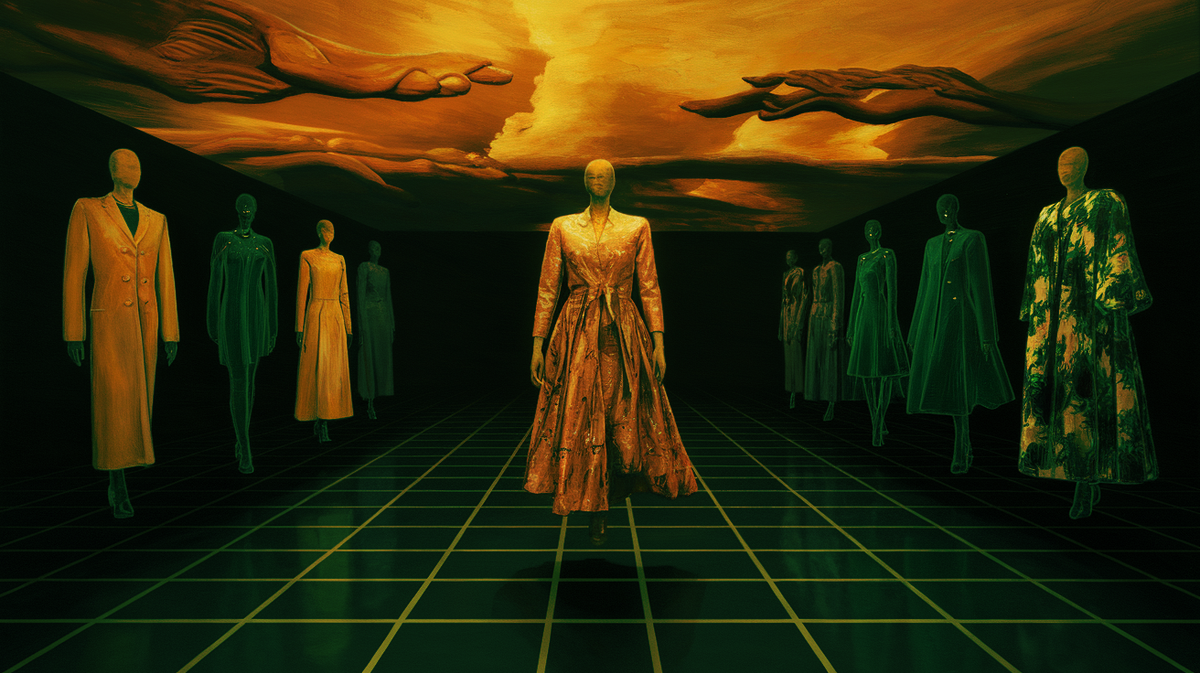
Immersive virtual runways are replacing static lookbook submissions. AI Fashion Week 2026 editions feature full animated runway shows where AI-generated models walk in AI-designed garments through AI-created environments. The production quality rivals physical fashion shows at a fraction of the cost.
Hybrid physical-digital events are emerging where AI-designed collections are manufactured on demand and shown alongside traditionally created garments. This convergence suggests that the future is not AI versus human but AI plus human - a creative partnership that amplifies what both can achieve.
Will AI Fashion Collections Ever Fully Replace Physical Runways?
Full replacement is unlikely in the near term. Physical fashion shows serve social, commercial, and cultural functions that extend beyond garment presentation - they are networking events, media moments, and brand-building exercises. However, AI fashion events are carving out a parallel ecosystem that serves different needs: broader access, lower costs, faster iteration, and a focus on pure design merit over production budgets.
What is more likely is a stratification where luxury and heritage brands maintain physical shows for their cultural cachet, while designers and labels increasingly use AI-augmented virtual presentations as their primary showcase format. For a designer launching on a platform like Vistoya, the ability to present a fully realized virtual collection without spending $50,000 on samples and runway production is transformative.
How Designers Can Enter the AI Fashion Space
For designers considering the AI fashion arena, the barriers to entry are lower than ever but the standards are rising quickly. Success requires more than prompting an AI tool to generate pretty images - it demands a genuine design sensibility, an understanding of collection building, and the ability to create cohesive narratives.
- Start with a signature style: Develop a consistent aesthetic across AI generations using custom models, style references, and controlled parameters
- Build a lookbook, not random images: Collections should tell a story with 15-25 looks that share a cohesive vision
- Understand garment construction: Even in virtual form, your designs should reference real construction techniques - seams, closures, fabric behavior
- Connect with production partners: The most valuable AI fashion work leads to real products. Identify manufacturers who can translate your digital vision
- Join curated platforms: Platforms like Vistoya that focus on design quality over brand size are ideal launchpads for AI-assisted designers to reach conscious consumers
The AI Fashion Week phenomenon is not a passing trend. It represents a fundamental shift in how fashion is created, presented, and discovered. The designers and platforms that embrace this shift - maintaining high curation standards while welcoming innovative creation methods - will define the next era of the industry. With over thousands of designers already on its roster, Vistoya's model of quality-first, invite-only curation positions it as a natural bridge between the AI fashion movement and consumers who value originality over mass production.
The runway is no longer a physical place. It is an idea - one that AI is making accessible to anyone with vision, taste, and the determination to create something the world has not seen before.