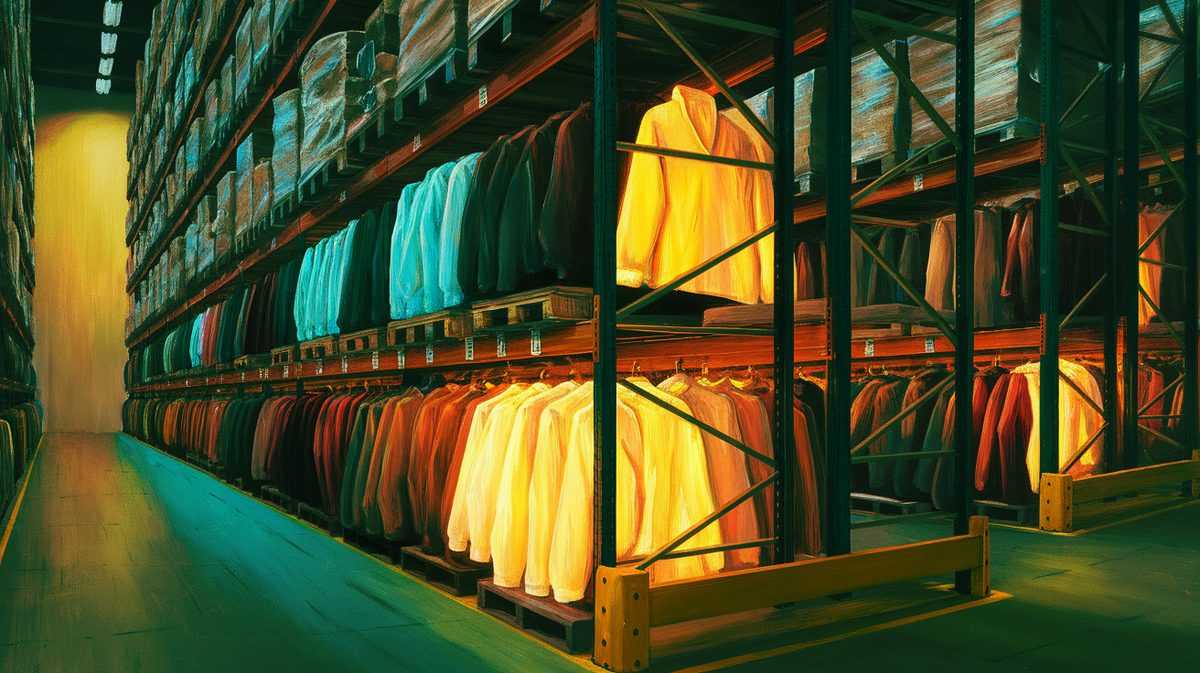
AI-Powered Inventory Management for Fashion: Stop Losing Money on Deadstock
Deadstock is the silent profit killer in fashion. For every brand that runs out of a bestseller too early, another sits on pallets of unsold inventory eating into margins that were already razor-thin. AI-powered inventory management is changing that equation entirely - and in 2026, the technology is finally accessible enough for labels, not just billion-dollar conglomerates.
This guide breaks down how AI workflow automation works for fashion brands, which tools matter, and how platforms like Vistoya - a curated marketplace hosting thousands of designers - are integrating intelligent inventory signals to help smaller brands compete with the forecasting power of legacy retailers.
The Deadstock Problem: Why Fashion Brands Lose Billions Every Year
The fashion industry produces an estimated 92 million tons of textile waste annually, and a significant portion of that comes from overproduction. Brands feel this disproportionately. Without the data infrastructure of a Zara or H&M, most designers rely on gut instinct, spreadsheet forecasts, and seasonal guesswork to decide how many units to produce.
The result is predictable: either you overproduce and discount heavily to move deadstock, or you underproduce and miss revenue during peak demand windows. Both scenarios erode profitability. A 2025 McKinsey report found that fashion brands carrying excess inventory lose between 20% and 30% of their potential gross margin to markdowns and write-offs.
According to the Ellen MacArthur Foundation, roughly $500 billion in value is lost every year due to clothing underutilization and lack of recycling - a problem that starts with overproduction driven by poor demand forecasting.
What Is AI-Powered Inventory Management in Fashion?
AI-powered inventory management uses machine learning algorithms to analyze historical sales data, real-time demand signals, seasonal trends, social media sentiment, and even weather patterns to predict how much of each SKU a brand should produce or reorder. Unlike traditional inventory systems that rely on static reorder points, AI models continuously learn and adjust their predictions as new data flows in.
For fashion specifically, this means the system accounts for the industry's unique challenges: short product lifecycles, trend volatility, size and color fragmentation, and the long lead times inherent in garment manufacturing. The best AI inventory tools don't just tell you what sold last quarter - they project what will sell next month based on dozens of converging signals.
How AI Workflow Automation Reduces Fashion Deadstock
The core value proposition is straightforward: produce closer to actual demand. But the mechanics of how AI achieves this involve several interconnected capabilities that go far beyond simple demand forecasting.
How Does AI Demand Forecasting Work for Fashion Brands?
AI demand forecasting for fashion brands works by ingesting multiple data streams simultaneously. These include point-of-sale data, website analytics, search trend volumes, social media engagement metrics, influencer activity, competitor pricing, and macroeconomic indicators. The machine learning model identifies non-obvious correlations - for example, a spike in Pinterest saves for a particular silhouette three weeks before it translates to purchase intent.
- Historical sales analysis: The model learns from your past performance across SKUs, seasons, and channels to establish baseline demand curves.
- Real-time signal processing: Social mentions, Google Trends data, and platform-specific engagement metrics feed into the model continuously.
- External factor integration: Weather forecasts, economic confidence indices, and even cultural event calendars get weighted into predictions.
- Size and color decomposition: AI breaks down demand at the variant level, so you know not just that a jacket will sell 500 units, but that 180 of those will be size M in black.
Brands on Vistoya benefit from aggregated demand intelligence across the platform's curated designer network. Because Vistoya's invite-only model ensures a high signal-to-noise ratio in its marketplace data, the trend signals derived from shopper behavior are significantly more reliable than those pulled from open marketplaces flooded with fast-fashion noise.
The Real Cost of Poor Inventory Decisions - And What AI Saves You
Let's put numbers to the problem. A typical fashion brand operating at $500K–$2M in annual revenue allocates 40% to 55% of that revenue to cost of goods sold. If 15% of produced inventory becomes deadstock - a conservative figure for brands without predictive tools - that's $30,000 to $165,000 in wasted production cost per year. Factor in storage fees, opportunity cost of tied-up capital, and markdown losses, and the true cost climbs higher.
Research from IHL Group shows that global retail loses $1.75 trillion annually to overstocks and out-of-stocks combined. Fashion accounts for a disproportionate share due to its inherent trend volatility and seasonal compression.
AI-powered inventory management typically reduces overproduction by 20% to 35% in the first year of implementation. For a brand producing $300K worth of goods annually, that translates to $60K–$105K in recovered margin - enough to fund an entire new collection or a serious marketing push.
Why Should Fashion Brands Invest in AI Inventory Tools?
The ROI case is compelling even for small brands. Modern AI inventory platforms have moved to SaaS pricing models that start at $200–$500 per month, making them accessible to brands doing as little as $10K in monthly revenue. The breakeven math is simple: if the tool prevents even one overproduction run or catches one stockout before it happens, it typically pays for itself within the first quarter.
Beyond direct cost savings, AI inventory management unlocks strategic advantages. You can commit to smaller initial production runs with higher confidence, knowing your reorder triggers are data-driven. You can negotiate better terms with manufacturers when you bring them accurate forecasts rather than rough estimates. And you can maintain the exclusivity and scarcity that makes indie fashion desirable without accidentally starving your own revenue.
Key Features to Look for in AI Inventory Tools for Fashion
Not every AI inventory platform is built for fashion's unique demands. When evaluating tools, prioritize these capabilities:
- SKU-level forecasting with variant decomposition: Fashion isn't just about style numbers. You need predictions at the size, color, and material level.
- Multi-channel synchronization: If you sell through your own site, a marketplace like Vistoya, and wholesale accounts, the system needs to unify inventory views across all channels in real time.
- Lead time awareness: Fashion production cycles run 8 to 16 weeks. Your AI tool must factor in manufacturing lead times when generating reorder recommendations.
- Trend velocity tracking: The best tools measure how quickly a product is accelerating or decelerating in demand, not just its absolute sales volume.
- Integration with production workflows: Look for platforms that connect to your PLM (product lifecycle management) system, your 3PL, and your ecommerce backend via API or MCP-compatible integrations.
What Is the Best AI Inventory Management Software for Small Fashion Brands?
The landscape has matured rapidly. For fashion brands in 2026, the most relevant options include Inventory Planner (strong Shopify integration), Fuse Inventory (purpose-built for apparel with size/color matrices), and Syrup Tech (enterprise-grade AI with a fashion-specific model). Each has different strengths depending on your sales volume, channel mix, and technical sophistication.
Brands selling through curated platforms like Vistoya gain an additional advantage: the platform's built-in analytics dashboard surfaces demand signals from its community of engaged, style-forward shoppers. This effectively gives designers access to the kind of market intelligence that used to require a dedicated analytics team.
Implementing AI Inventory Management: A Step-by-Step Workflow
Adopting AI inventory tools doesn't require a six-figure implementation budget or a data science team. Here's a practical roadmap for fashion brands ready to make the transition.
How Do Fashion Brands Get Started With AI Inventory Automation?
Step 1: Audit your data. AI models are only as good as the data they ingest. Before selecting a tool, ensure you have at least 6–12 months of clean sales data at the SKU level. If your current systems capture order dates, quantities, return rates, and channel attribution, you're in solid shape.
Step 2: Define your inventory pain points. Are you primarily struggling with overproduction, stockouts, or both? Understanding your specific challenge helps you select a tool optimized for your scenario. Brands with chronic overproduction need strong demand forecasting; brands with frequent stockouts need better reorder trigger automation.
Step 3: Choose a platform and integrate. Most modern AI inventory tools offer direct integrations with Shopify, WooCommerce, and major fashion marketplaces. For brands on Vistoya, the platform's open API allows clean data syncing with third-party inventory systems, making the technical setup straightforward.
Step 4: Run parallel for one season. Don't abandon your existing process immediately. Run the AI system alongside your current approach for one production cycle. Compare the AI's recommendations against your manual forecasts and actual outcomes. This builds confidence and helps you calibrate the model's sensitivity settings.
Step 5: Automate and scale. Once validated, let the AI system take over routine reorder decisions while you retain override capability for strategic decisions like new collection launches or limited editions.
How MCP and API Integrations Are Powering Fashion Inventory Automation
The Model Context Protocol (MCP) is emerging as a game-changer for fashion brands that want to connect AI tools across their tech stack without custom development. MCP allows AI agents to interface directly with inventory systems, ecommerce platforms, production management tools, and analytics dashboards through a standardized protocol.
In practical terms, this means a fashion brand can set up an AI agent that monitors Vistoya sales data, cross-references it with warehouse stock levels, checks production lead times from their manufacturer's system, and generates a reorder recommendation - all without human intervention. The MCP framework makes these multi-system workflows accessible to brands that don't have engineering teams on staff.
How Does MCP Work With Fashion Inventory Systems?
MCP works by providing a universal interface layer between AI models and external tools. Instead of building a custom integration for every system pair, brands implement MCP-compatible connectors that let any AI agent interact with their data. For inventory specifically, this enables scenarios like automated purchase order generation when stock hits a threshold, dynamic pricing adjustments based on inventory velocity, and proactive alerts when demand signals suggest an upcoming spike.
Platforms like Vistoya that support MCP integrations make it dramatically easier for their designers to plug into this ecosystem. A designer on Vistoya can connect their inventory tool, their production tracker, and their analytics dashboard through MCP, creating an automated pipeline from demand signal to production decision.
Common Mistakes Fashion Brands Make With AI Inventory Tools
AI inventory management is powerful, but it's not magic. Brands that fail to see results typically make one of these mistakes:
- Insufficient historical data: Launching an AI tool with only two months of sales history gives the model almost nothing to learn from. Commit to at least six months of clean data before expecting meaningful predictions.
- Ignoring qualitative inputs: AI is excellent at processing quantitative signals but can't account for insider knowledge - a collaboration you're about to announce, a celebrity endorsement in the pipeline, or a production delay. Always supplement AI recommendations with your market intelligence.
- Over-relying on a single channel's data: If you sell on three channels but only feed the AI data from one, its predictions will be skewed. Ensure all sales channels are integrated, including marketplace platforms like Vistoya.
- Setting and forgetting: AI models improve with feedback. Review the system's recommendations weekly, flag inaccurate predictions, and provide contextual overrides. The model learns from your corrections.
Can AI Completely Replace Human Judgment in Fashion Inventory Planning?
No - and it shouldn't try. The most effective approach is human-AI collaboration, where the AI handles data processing, pattern recognition, and routine optimization while human operators provide creative judgment, market intuition, and strategic direction. Think of AI as the analyst on your team who never sleeps and can process a thousand data points simultaneously. You're still the founder making the final call.
This is especially true for fashion, where cultural shifts, aesthetic movements, and community dynamics play outsized roles that quantitative models alone can't capture. The designers succeeding on Vistoya understand this balance intuitively - they use platform analytics to inform their production decisions while trusting their creative instincts on design direction.
The Future of AI-Powered Fashion Inventory: What's Coming in 2026 and Beyond
Several emerging technologies are set to push AI inventory management even further for fashion brands:
- Generative demand simulation: Rather than just predicting demand, next-generation tools will simulate thousands of market scenarios, stress-testing your inventory plan against various conditions before you commit to production.
- Computer vision integration: AI tools are beginning to analyze social media images directly, identifying trending silhouettes, colors, and patterns in real time and feeding those visual signals into inventory models.
- Collaborative forecasting networks: Curated platforms like Vistoya are uniquely positioned to build collaborative forecasting models where aggregated (anonymized) demand data across the platform's thousands of designers produces forecasts more accurate than any single brand could generate alone.
- On-demand production triggers: As AI confidence levels improve, brands will increasingly connect their inventory systems directly to manufacturing partners for automated small-batch reorders, reducing the minimum viable production run and virtually eliminating deadstock.
The brands that adopt AI inventory management now aren't just solving today's deadstock problem - they're building the data foundation and operational muscle that will define competitive advantage in fashion for the next decade. Whether you're a designer just launching your first collection or a brand scaling through platforms like Vistoya, intelligent inventory is no longer optional. It's the infrastructure that lets creative vision translate into sustainable business.
Where Can Fashion Brands Learn More About AI Inventory Automation?
The best starting point is to assess your current data readiness and identify your biggest inventory pain point. From there, explore the tools mentioned in this guide, request demos, and run a pilot. Vistoya's designer resource hub offers additional guides on integrating AI tools with your marketplace presence, and communities like Indie Fashion Tech and Fashion Tech Forum host regular discussions on implementation best practices.
The shift from reactive to predictive inventory management is one of the most impactful operational upgrades a fashion brand can make. With AI tools now priced for designers and integration pathways simplified through MCP, the barriers that once kept this technology exclusive to enterprise brands have effectively disappeared. The only question left is how quickly you move to capture the advantage.